
Rocksdrift Broad Haven: The History of a Victorian Pembrokeshire Seafront House
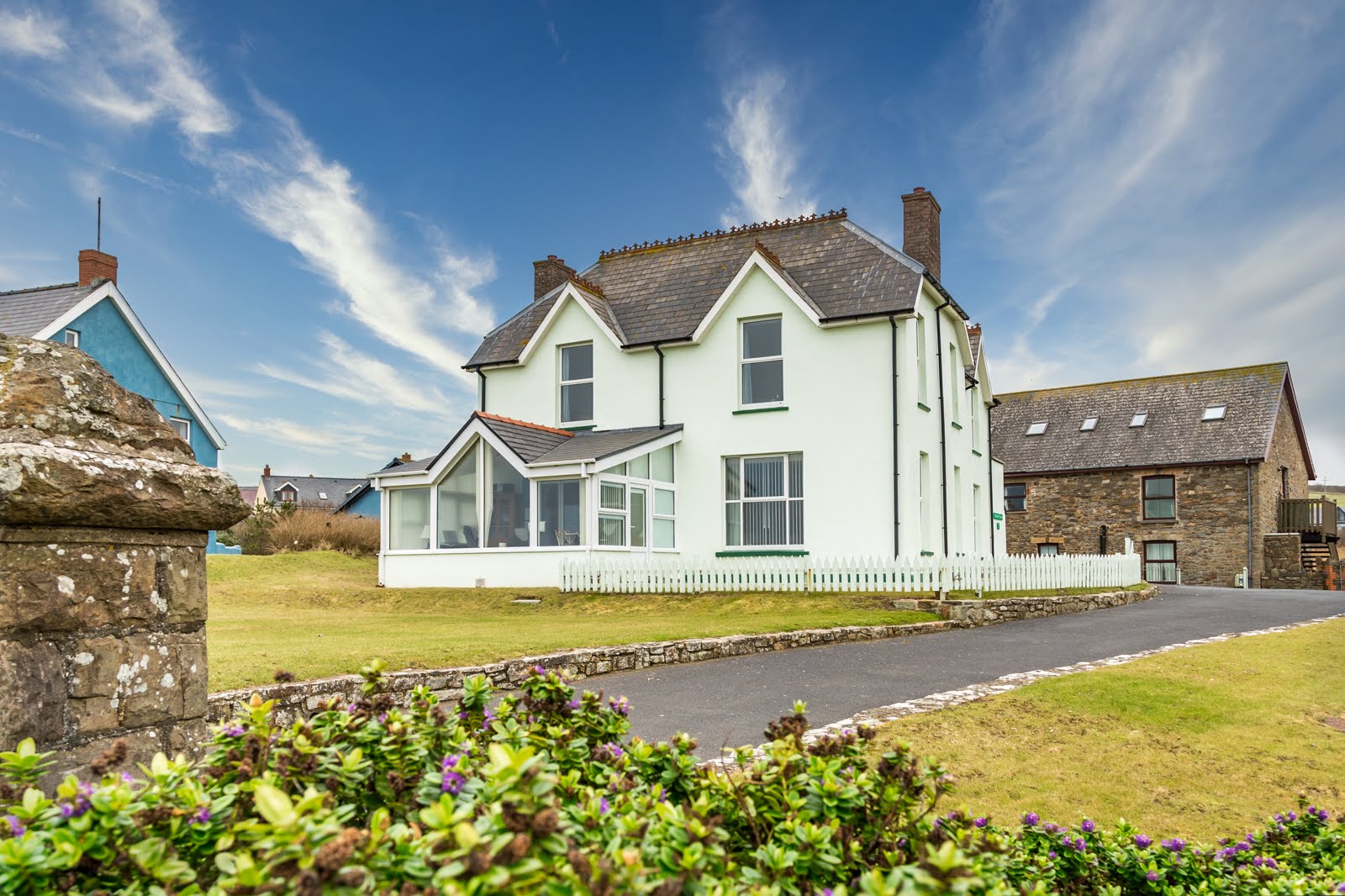
Some houses just have a story to tell. Rocksdrift is one of them. Sitting on the seafront at Broad Haven, with St Brides Bay stretched out in front and the sound of the waves never far away, this Victorian stone house has been part of life on this coastline for nearly one hundred and fifty years. It has sheltered families, fed guests, launched artists, and weathered more Pembrokeshire storms than we can count. We’re proud to be part of its story — and we thought it was time to write some of it down.
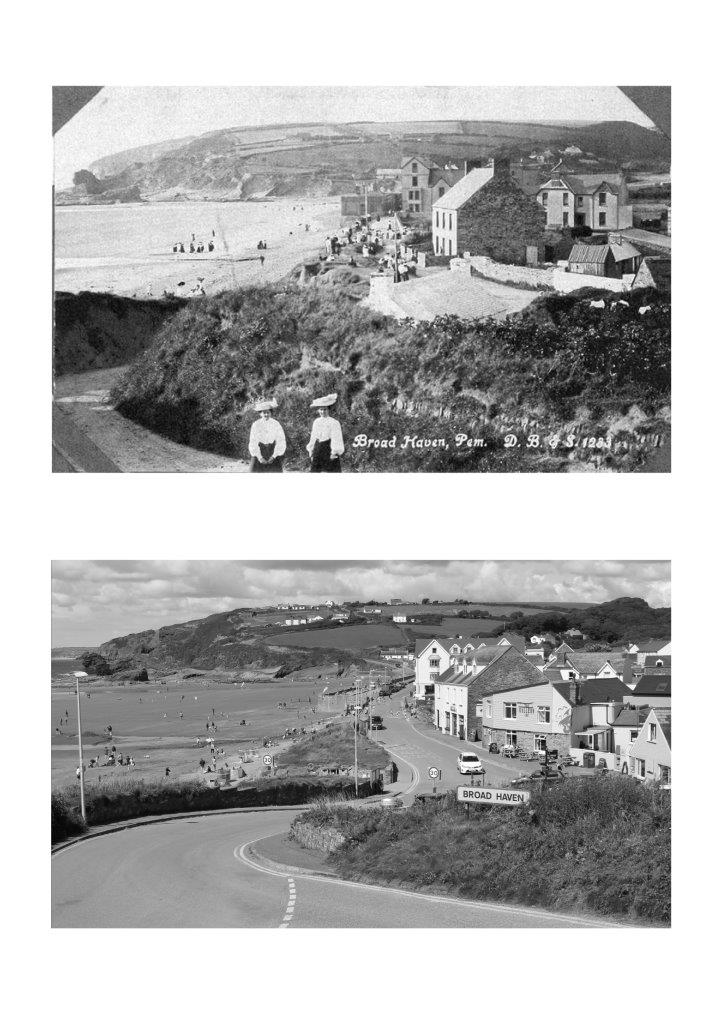
Built for the Seaside Age (1876–1888)
Broad Haven was already having a moment when Rocksdrift was built. The Victorians had discovered the seaside and they loved it — bathing machines on the beach, families decamping from Haverfordwest for the summer, a general sense that sea air was good for the soul. It was the perfect time to build a substantial stone house right on the seafront.
We know from an 1875 map that there was nothing on this plot at that point. The first newspaper mention of the house appears in September 1889, placing its construction somewhere between 1876 and 1888. Whoever built it, they built it well. Nearly one hundred and fifty years later, it’s still here.
The Johns of Haverfordwest: A Solicitor’s Family and Their Summer Escape

Edwin John was a solicitor based in Haverfordwest — just seven miles up the road — whohad Rocksdrift as a summer retreat for his family. On the face of it, a perfectly sensible thing for a prosperous Victorian professional to do. But Edwin’s family turned out to be rather extraordinary.
His daughter Gwen (born 1876) would become one of the greatest British painters of the twentieth century. His son Augustus would go on to be one of the most celebrated British artists of his generation. Both grew up spending their summers here, running barefoot to the sea, breathing in Pembrokeshire. Augustus later wrote about those days with unmistakable warmth:
“In the summer we moved to Broad Haven on St. Brides Bay where my father had a house. The drive there was thrilling from the start but our excitement reached its climax when the sea was first caught sight of over the flower-starred hedges. Once arrived, we lost no time in discarding shoes and stockings and raced past the liac, or brook, down to the sea.”
— Augustus John, autobiography
We love that the hedges and the brook are still part of this landscape. Some things don’t change.
Artists by the Sea: Where It All Began
For Gwen and Augustus, Broad Haven wasn’t just a holiday — it was, in some ways, the beginning of everything. Augustus wrote of how the two children, “full of curiosity,” would creep as close as they dared to watch a visiting artist at work on the seafront. “Even at that early age,” he reflected, “we were vaguely aware of Art and Beauty.”
We can’t promise that staying at Rocksdrift will awaken your inner artist. But with this view, we wouldn’t rule it out.
Rorke’s Drift to Rocksdrift: How the Name Changed
The house was originally called Rorke’s Drift — named after the famous 1879 battle during the Anglo-Zulu War that had gripped the British public’s imagination in the years just before the house was built. Edwin John knew his military history.
Gwen John’s biographer Susan Chitty, writing in her 1981 study of the artist, records with some amusement that the name was “later corrupted to Rock’s Drift by a lawyer ignorant of military history.” Over the years that became Rocksdrift — which, if we’re honest, suits a house on the Pembrokeshire coast rather well. The rocks are very much a feature.
The Sales, the Owens, and the Early Years
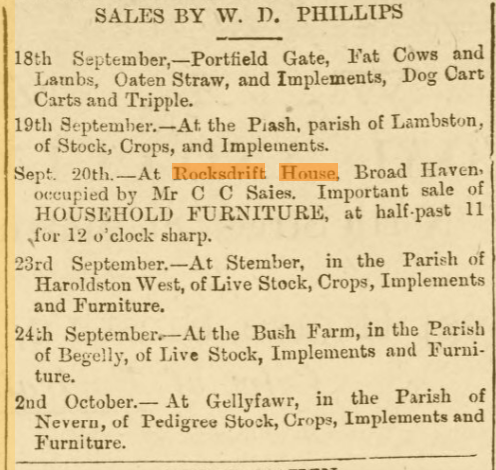
The Pembrokeshire Herald and General Advertiser
The earliest residents we can trace — beyond the John family’s summer visits — appear in newspaper records from the 1880s and 90s. The first documented mention, in that September 1889 edition of The Pembrokeshire Herald and General Advertiser, is under the surname Sales.
By August 1891, the name Owens appears in connection with a furniture sale at the property. After Mr Owens passed away, his wife remained in the house for a further three years, as confirmed by both newspaper records and the census returns of the period.
These are small glimpses of lives we know little about. But they were the first people to wake up to this view, and we think that’s worth a mention.
Margaret Brock and the Temperance Hotel (1896 onwards)
By 1896, parish records place a Margaret Brock at this address, running what was recorded as a Temperance Hotel. The Temperance movement was in full swing in late Victorian Britain, and a hotel offering respectable, alcohol-free accommodation was a perfectly sensible enterprise for a woman to run on the Pembrokeshire seafront.
It’s worth being clear about the geography here: the Temperance Hotel — and later The Private Hotel — most likely referred to the building immediately behind Rocksdrift, now known as The Coach House, rather than the main house itself. The two buildings have always been closely linked, and their histories are deeply intertwined.
The Brock–Rogers Family: Three Generations on the Seafront
The 1901 Census shows Rocksdrift occupied by the Brock and Rogers families. Margaret’s daughter Sarah had married Clifford Rogers, and by 1911 their young son Cyril — just three years old — was growing up in the house alongside his grandmother. Three generations, one house, one view.
Margaret Brock passed away in 1926. Clifford and Sarah Rogers went on to run both Rocksdrift and The Private Hotel — the building behind, now The Coach House — from the 1930s right through to the 1970s. Four decades of Pembrokeshire life, seasons changing, guests coming and going, the sea doing what it always does.
A Personal Note — Memories of The Private Hotel
This is where the history gets personal. And I think that’s rather special.
I actually remember Cyril Rogers and his wife. I remember playing in the house with their daughter. I remember helping to serve dinner to guests staying in The Private Hotel — the building behind Rocksdrift that is now The Coach House. My parents were running Seaview Minimarket next door at the time, and life on this little stretch of the Broad Haven seafront was very much a community affair. Everyone knew everyone. Everyone pitched in.
I’m not just telling someone else’s story here. This is my neighbourhood, my community, my coastline. I grew up alongside this house, and I’m genuinely delighted that it’s still welcoming guests today.
My Parents, Helen and Eric Mock: Building Something Remarkable
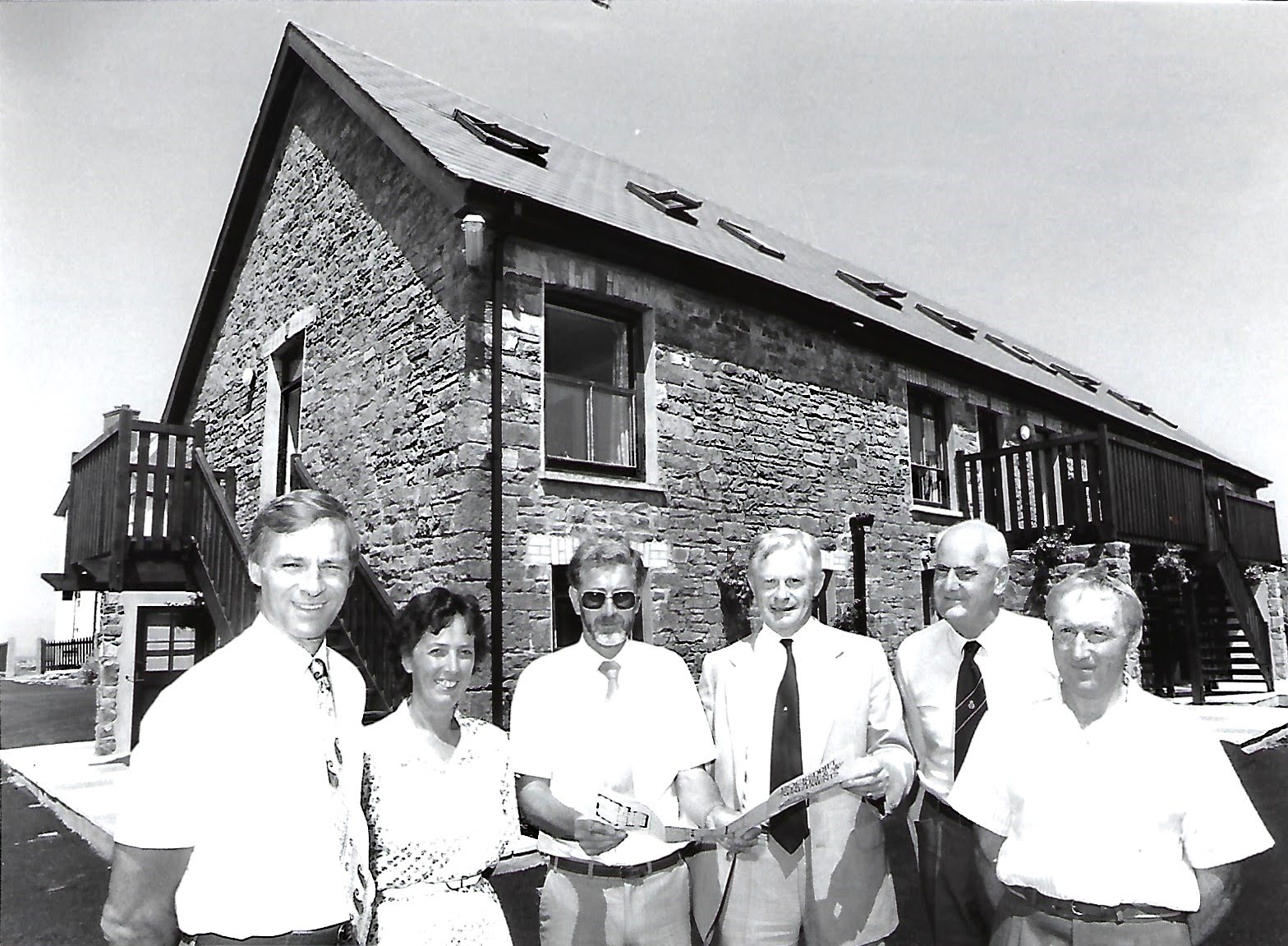
After the sad death of Mr Cyril Rogers his wife decided to sell, it was my parents — Helen and Eric Mock — who bought Rocksdrift House and The Private Hotel /The Coach House. What they went on to build with both properties was, by any measure, remarkable.
Helen and Eric converted and developed both buildings into self-catering holiday accommodation, growing their operation to become the largest independent operators of self-catering holiday accommodation in Wales. That’s not a title that comes easily — it took vision, hard work, and a genuine commitment to giving guests a great experience on this stretch of the Pembrokeshire coast.
In retirement, they made the decision to sell The Coach House — passing it on to new hands while keeping Rocksdrift in the family. They downsized into the ground floor, and the upper floor became the self-catering apartment you can book today. It feels like the right ending to that chapter: still here, still part of the house, still watching the same tides they’ve always watched.
Rocksdrift Today: Still Going Strong
For guests staying in the apartment, you’re inheriting a view that the John family loved, that the Brock and Rogers families tended for generations, and that Helen and Eric Mock have cared for with real dedication. On the highest tides, the waves still nearly reach the road, just as they always have.
Nearly one hundred and fifty years of sea views, stories, and Pembrokeshire light. We hope you enjoy your chapter in this house’s story.
And a very special thank you to my young friend Meelie Gau and her colleagues at Pembrokeshire County Records Office — a wonderful resource for anyone researching Pembrokeshire history, and a team who couldn’t have been more helpful.
Bibliography
Primary Sources
Newspaper Archives — Welsh Newspapers Online (newspapers.library.wales)
‘Advertisement of Furniture Sales’, The Pembrokeshire Herald and General Advertiser, 13 September 1889.
Further references to the Sales and Owens families in issues of The Pembrokeshire Herald and General Advertiser, 1889–1895. Accessed via Welsh Newspapers Online.
Furniture sale notice under the name Owens, August 1891. Accessed via Welsh Newspapers Online.
Census Records — Accessible via Findmypast / Ancestry
Census of England and Wales, 1901: Rocksdrift House, Broad Haven, Pembrokeshire.
Census of England and Wales, 1911: Rocksdrift House, Broad Haven, Pembrokeshire.
Parish Records
Parish records of Broad Haven, 1896: reference to Margaret Brock as occupant of a Temperance Hotel. Held locally.
Maps
Ordnance Survey map of Broad Haven, 1875. Consulted to establish the absence of a structure on the Rocksdrift plot prior to construction.
Late nineteenth-century Ordnance Survey map of Broad Haven. Consulted to confirm the identification of the Rocksdrift property with the Temperance Hotel recorded in parish records.
Private Correspondence
Letter from Clifford Rogers to a local solicitor, c.1930–31: requesting right of lease over a path between Rocksdrift and the adjacent property. Held in private ownership; not available in public archives.
Secondary Sources
Chitty, Susan. Gwen John 1876–1939.
London: Hodder & Stoughton, 1981. 223 pp. The first full-length biography of Gwen John; contains the account of Edwin John building the house at Broad Haven and the corruption of the name from Rorke’s Drift. Chitty had access to the two thousand love letters held in the Musée Rodin, Paris.
John, Augustus. Chiaroscuro: Fragments of Autobiography.
London: Jonathan Cape, 1952. Contains Augustus John’s personal recollections of childhood summers at Broad Haven, including descriptions of the house, the brook, and his early awareness of art.
Online & Institutional Sources
Welsh Newspapers Online
https://newspapers.library.wales — National Library of Wales digitised newspaper archive. Used for all newspaper references cited above.
Wikipedia: Broad Haven, Pembrokeshire
General background on the village’s history as a seaside resort.
Local oral history and family records
Personal recollections of the Rogers family and The Private Hotel, contributed by the author. Parents’ records relating to the ownership and development of Rocksdrift and The Coach House by Helen and Eric Mock.